Growing Comfrey for Garden and Farm
"Thank you for
the great information on your website regarding comfrey and the multiple beneficial
uses for it." -Chris, Oakland, California
 |
USDA
Hardiness Zones and Comfrey
Comfrey is
a hardy, robust perennial good in Zones 3-9 so it can be planted everywhere
in the United States except northern Alaska and the southern tip of Florida.
Though some people do have success growing comfrey in southern Florida.
Be sure to plant it in partial shade and not in full sun in hot climates.
"The Comfrey Bocking #14 grows quickly
producing large leaves that are filled with nutrients. The cold won't hurt
it as it is hearty down to minus 35 degrees and it loves the Florida sun."
-South Florida Gardening, Hollywood, Florida, Zone 10
According to the "Eat Local Guide" of Sarasota, Florida, Zone 9: "Comfrey
does well in Florida gardens, growing year-round. It is better grown in
the ground than in a pot and needs to be cut back in January or February.
You can start comfrey anytime, although it is best to start it in the spring."
|
 |
Seasons
to Plant Comfrey
Comfrey roots
can be planted any time the soil can be worked.
The best time to plant is in the spring or fall. It is better if some growth
occurs in the fall before the leaves (but not the roots) are killed by frost
but it is not essential. Freezing temperatures do not kill comfrey roots.
If planted in the winter in cold climates, the crown and roots remain dormant
until early spring.
|
|
Invasiveness
of Comfrey
Comfrey Bocking
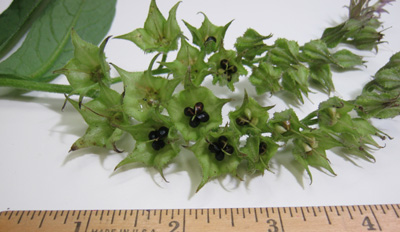
varieties such as #4 and #14 are not invasive. The seeds are sterile (will
not grow). True or Common Comfrey is somewhat invasive from the seeds spreading.
None of them have invasive roots.
If you want to change the location of your comfrey patch, it is difficult
to dig up every bit of root.
|
 |
Plant
Location and Care
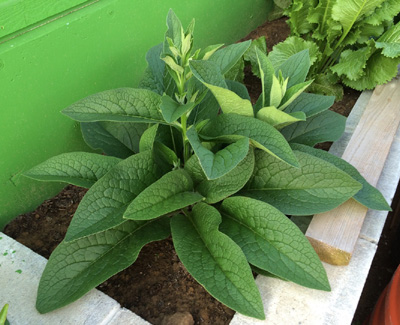
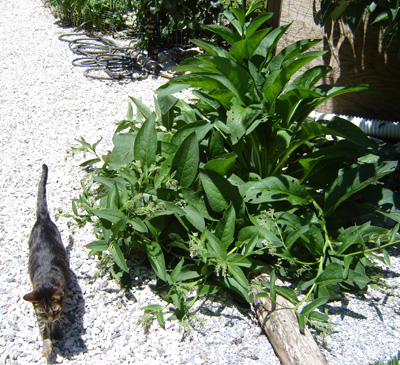
The photo
is a 3-month-old Russian comfrey plant that Jason in West Virginia grew
from small roots.
Comfrey plants prefer full sun or partial shade (no deep shade). The mature
size is 3-5 feet tall and 2-4 feet wide. It prefers soil pH of 6-7 but it
is not picky. It does well in most soils but prefers a rich soil with a
lot of nitrogen.
Comfrey does not require much care. It is unusual for insects, viruses,
fungi or bacteria to bother it. However, weak or stressed plants may get
rust or mildew (fungal diseases). Infected plants should not be used for
propagation.
Comfrey
is Hardy
Shoots start
coming up in early spring. Flowers bloom late spring through summer. Leaves
can take frost down to 15 degrees and still survive. Roots survive to -40
degrees.
It is very drought tolerant because it has deep roots. But it is better
to water it if there is drought.
Keep well fertilized with manure and other types of nitrogen. It can be
fertilized with urine diluted 50:50 with water.
|
 |
Planting
Comfrey
Bury comfrey
roots about 2-3 inches deep. In clay soil plant somewhat shallow; in sandy
soils plant deeper.
Space Russian comfrey plants 2-3 feet apart in all directions. Space True / Common
comfrey 1-2 feet apart.
It likes fast draining soil. Do not overwater. You can kill plants if the
soil is always wet. Let soil dry out between watering. Comfrey roots rot
if there is too much water.
Plants live about 10 years before they go into decline. If you divide your
roots every few years, the plants are rejuvenated and live forever.
|
 |
Dividing
Mature Plants
Plants
are mature at 2 years or older and continue to expand every year. Once a
plant is well established you can divide it. Almost all transplants survive.
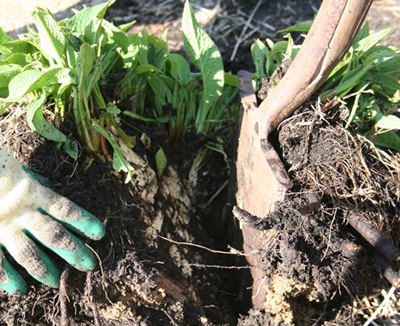
Divide by pushing your shovel vertically through the plant in the middle
of the crown (this photo). Take half of the crown with the roots. Divide
the roots into 6-8 inch pieces and plant elsewhere.
Or drive a shovel horizontally through the leaf clump about 3-4 inches below
the soil surface. This removes the crown. Divide it into 6 inch pieces.
The original plant quickly recovers. Only divide plants that are strong
and healthy.
|
 |
Plant
a Patch, or Add to Pasture
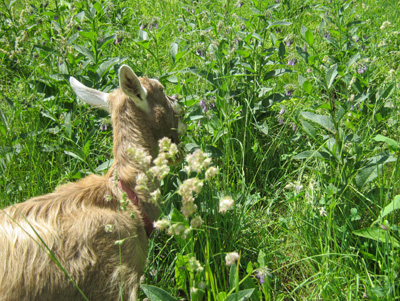
This is a
Toggenburg goat in a pasture of Russian comfrey and other plants. You can
grow it alone (monoculture) or with other plants (pasture, orchard, field).
Rotational grazing is a good method to use so plants have time to rebuild
before they are eaten again.
Another method is to have an area with comfrey that the grazing animals
can not reach. Then you cut the comfrey and bring it to the animals. I put
it in a hay rack since goats do not like it on the ground.
|
|
Buy Live
Comfrey Roots for Planting
Grow
your own Comfrey: True/Common Comfrey, Russian Bocking #4, Russian Bocking
#14, Symphytum Hidcote Blue.
Your order includes a flyer about how to take care of your plants.
Comfrey
Easy Order Page
|
| |
|