COMFREY
AND HEALING
Medicine for Burns
See a medical practitioner if you are seriously burned.
Do not use comfrey externally on deep wounds.
|
|
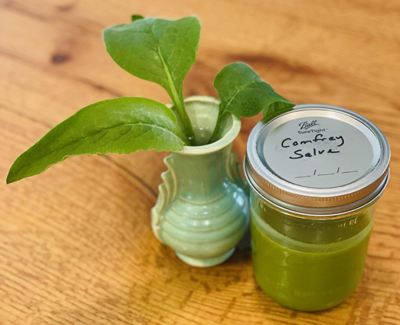
Comfrey Salve or Ointment to Heal Burns
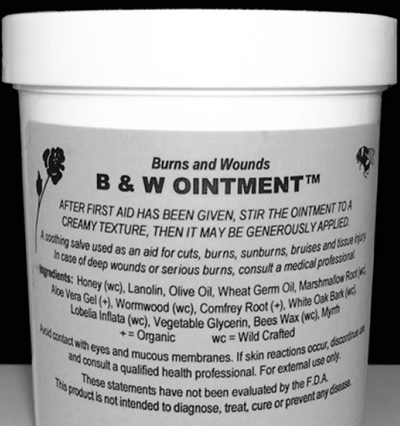
"This case report describes the phases of an ‘Amish Burn Care Project’ and the lessons learned throughout the process.
Amish, distinct by their horse and buggy travel, plain dress, and German dialect commonly known as Pennsylvania Dutch,
number over 250,000 across the United States and Ontario, Canada.
In 2008, a group of Amish in this region of Ohio, known locally as burn dressers, initiated a project with health care professionals
to document the outcomes of their burn care using the Burns and Wounds (B&W) Ointment® and Burdock Leaf
Therapy® (Amish Burn Study Group, Kolacz, Jaroch, Bear, & Hess, 2014).
They had observed that patients under their care seldom used analgesics (pain killers) and rarely experienced pain
during dressing changes in sharp contrast to conventional burn care (Kornhaber & Wilson, 2011; Malloy & Milling, 2010;
Morris, Louw, & Grimmer-Somers, 2009; Smith, Murray, McBride, & McBride-Henry, 2011).
The B&W Burdock Leaf Therapy® originated with an Amish man named John Keim (Keim, 1999). This herbal-based burn care
technique was born out of Keim’s intense desire to alleviate suffering associated with hospital-based care using opiates for pain
management and scrub tanks and skin grafts for wound care.
After discovering the efficacy of the B&W Ointment®, whose ingredients include honey, Comfrey, beeswax, lanolin,
aloe, lobelia, olive oil, wheat germ oil, and white oak bark (Amish Burn Study Group et al., 2014), and the burdock leaf for
pain reduction (Chan et al., 2011) during dressing changes, Keim trained hundreds of his fellow Amish to use this method
(‘Burn Certification List’ 2008)."
-‘Amish-Initiated Burn Care Project: Case Report and Lessons Learned in Participatory Research’ by Rosanna F. Hess, D.N.P.,
R.N. from ‘Research for Health, Inc.’, Ohio, Journal of Transcultural Nursing, 28(2), pages 1-8, November 2015.
Treatment
of Burns with 'Burns & Wounds' (B&W) Ointment and Leaf-2012 pdf
|
|
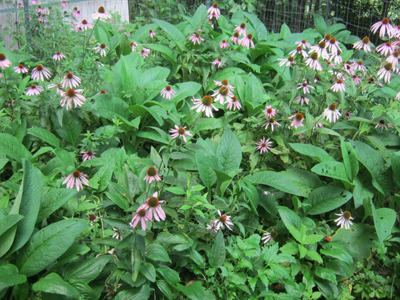
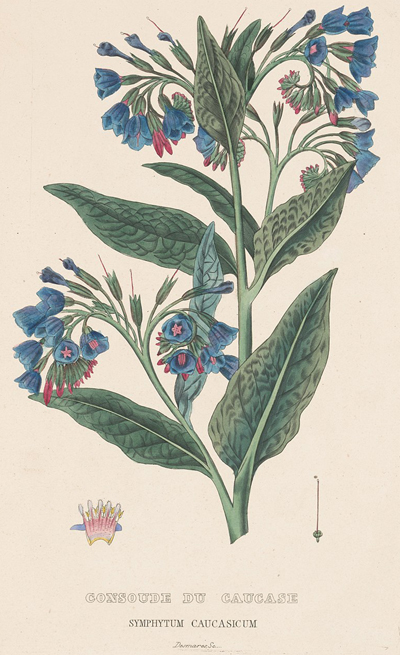
Symphytum and Burn Healing
"Burns can be caused by fire, sunlight, or chemicals.
First- and second-degree burns can generally be treated effectively at home,
but you must be certain to keep the area clean to avoid infection. If infection
should occur, seek medical advice. Always seek medical attention for third-degree
burns (the most serious burns).
To treat a burn, first cool the area, thus ‘putting out the fire’. Immerse the area in ice water or apply diluted apple cider vinegar compress to the damaged area for at least 30 mintues.
St.-Johns-Wort salve or oil applied topically is especially helpful for healing burns.
This particular salve is also excellent for rashes, cuts and wounds: 1 part calendula flower, 1 part Comfrey leaf, 1 part St.-Johns-Wort leaf and flower. Apply to the affected area two or three times daily."
-Rosemary Gladstar’s Herbal Recipes for Vibrant Health: 175 Teas, Tonics, Oils, Salves, Tinctures and Other Natural Remedies by Rosemary Gladstar. North Adams, Massachusetts: Storey Publishing, 2008, page 74-75.
"1. Pharmacological study of burn wound healing activity of ointment containing high-molecular polysaccharide (and
novel biopolymer) fractions from Comfrey roots (Symphytum asperum and S. caucasicum), free of allantoin and pyrrolyzidine
alkaloids, revealed that by efficiency it is superior to allantoin ointment.
2. The obtained results allow to assume that established burn healing activity of the composition is associated with synergistic
action of its constituents due to the shortening of the inflammatory phase of wound repair.
3. The established pharmacological action of ointment allows recommending it for treatment of second and third-degree
burns."
-‘Burn Healing Compositions from Caucasian Species of Comfrey (Symphytum L.)’ by Mulkijanyan, Barbakadze, Novikova,
Sulakvelidze, Gogilashvili, Amiranashvili, and Merlani, Bulletin of the Georgian National Academy of Sciences, Tbilisi, Georgia
(the country in Caucasus region of Eurasia), Volume 3, No 3, pages 114-117, 2009.
(Synergistic means the interaction of two or more substances that create a combined effect greater than the
sum of their separate effects. In other words, the whole is greater than the sum of its parts.)
|
|